Blog:
Time to update your B2B delegate acquisition playbook?
1 October 2026 minute read

Serious business event owners abandoned the ‘spray-and-pray’ email blast a long time ago, aware that these days, senior executives aren’t just worried about squandering their budgets – they’ve become ruthlessly protective of the one thing none of us get any more of in this life. Their time.
We live in a deeply cynical age. And the kind of high-flying delegate you’d like to have at your next conference knows that – more often than not – registering for a new event means two days of generic keynotes followed by an inbox flooded with pushy emails from vendors.
TL;DR it’s tough out there.
If you want to break through the negative preconception that your event is just one more in a line of cookie-cutter meetings – just another drag on the time of a jaded executive – you have to conjure up a more powerful, compelling vision of exactly what it will do for them.
Delegates care less about who’s speaking, or the reception at the winery, and more about the opportunities you can give them to make connections with peers and become more successful. And here’s the hard part: they want you to be specific.
For B2B event marketers, this means shifting your delegate acquisition strategy away from the traditional reliance on a flashy landing page and a prayer. Winning the registration‚ and actual attendance‚ of high-value decision-makers requires treating your event technology platform and your marketing tech stack as a unified engine of persuasion.
Here are some of the ways we see modern event marketers rewiring their tech infrastructure to turn indifferent targets into confirmed delegates.
Convert your agendas into ‘AI-Ready’ assets (AEO)
We all need to move with times – which is sad for me because I experienced ’90s fashion the first time around and it looked bad on me then.
But the first reality to confront here is that delegates are no longer finding your event in quite the same way they used to. Before a prospective attendee ever sees your registration page, they are likely asking an AI assistant for recommendations on industry trends, solutions, or networking opportunities. And with over 90% of B2B research paths now touching large language models (LLMs) and search engines like Google’s AI Overviews, conventional SEO isn’t enough anymore.
What’s the answer? Start by structuring your event website using rigorous Schema markup in JSON-LD format. Make sure your agenda tracking pages, session transcripts from previous years, and speaker bios are all cleanly exposed to search engine crawlers rather than locked behind hard walls or infinite-scroll Javascript grids.
Your platform should be able to tell you what measures they have in place to ensure your most interesting content is available to AI search, so when a target VP queries an AI assistant asking ‘What are the best supply chain risk conferences in Q4?’, your event sessions are indexed, cited, and ready to be recommended directly by the engine.
Activate ‘Agentic Outreach’ via CRM intent data
You’ll have noticed that a defining characteristic of the whole AI thing is that decisions are being taken faster. Waiting for a prospect to land on your registration page now means you might already be too late. Top-tier acquisition engines use behavioural intent signals to trigger outreach when a target account is actively experiencing the pain point your event solves.
So far so Minority Report I hear you say, but how do you tap into this? Well, you can connect intent intelligence platforms (like Bombora or 6sense) directly to your Salesforce or Hubspot CRM. When a tier-one target account spikes in research intensity around a specific topic, your stack can trigger automated, highly contextual outreach via your own AI sales assistants (like Jasper or Drift).
So instead of a generic ‘Register for our annual summit’ email, the prospect receives a hyper-personalised note: ‘I noticed your team is heavily focused on cloud compliance workflows this month. We’re hosting a closed-door executive roundtable specifically on this framework on November 12th. Here is an invite.’
Uncanny? Perhaps. But this is the way the world’s going.
Leverage ‘Thought Leader Ads’ on LinkedIn
A wise man once said: ‘Guns don’t kill people; rappers do’. Similarly, brands don’t register for events; people register to meet other people.
Relying strictly on your company’s branded social channels to drive paid registrations gets you lower CTRs and higher acquisition costs.
A better alternative can be to utilise LinkedIn’s Thought Leader Ads format. It allows your event marketing team to financially boost posts directly from the personal profiles of your keynote speakers, internal executives, or advisory board members.
You can connect these ads directly to native LinkedIn Lead Gen Forms, which automatically push registrant data straight into your event management platform (eg AttendZen) via webhook integrations.
This works because a post from an industry influencer previewing a controversial panel discussion feels native and trustworthy. A user can register seamlessly in two taps without ever leaving their social feed, cutting registration friction by up to 40%.
Move to ‘Zero-Cookie’ value exchanges at registration
With third-party cookies clinging on by their crumbly fingertips, and tracking restrictions tightening globally, delegates are unsurprisingly ever more transactional with their data.
Asking a prospect to fill out a 12-field registration form in exchange for seeing a basic event brochure will get you massive cart-abandonment rates in 2026.
So what should you do instead?
One solution is to try a little reciprocity. You might consider building a personalised data tool or diagnostic mini-app directly into the early stages of your registration flow. Maybe the registrant gets immediate access to a custom internal GPT tool that analyses their team’s maturity score based on 3 simple questions. Or maybe you just grant instant access to a premium industry benchmark report.
Either way, the point is that you offer value before they click submit. And in doing so, suddenly the registration becomes a fair, mutually beneficial value trade.
Sell the ‘Predictive Room’ via your event app
Remember, senior delegates don’t attend events to be sold to; they show up to network with their peers who share more-or-less the same nature and scale of problems they have. That’s why your acquisition copy always tends to major on your networking opportunities rather than your headline speakers.
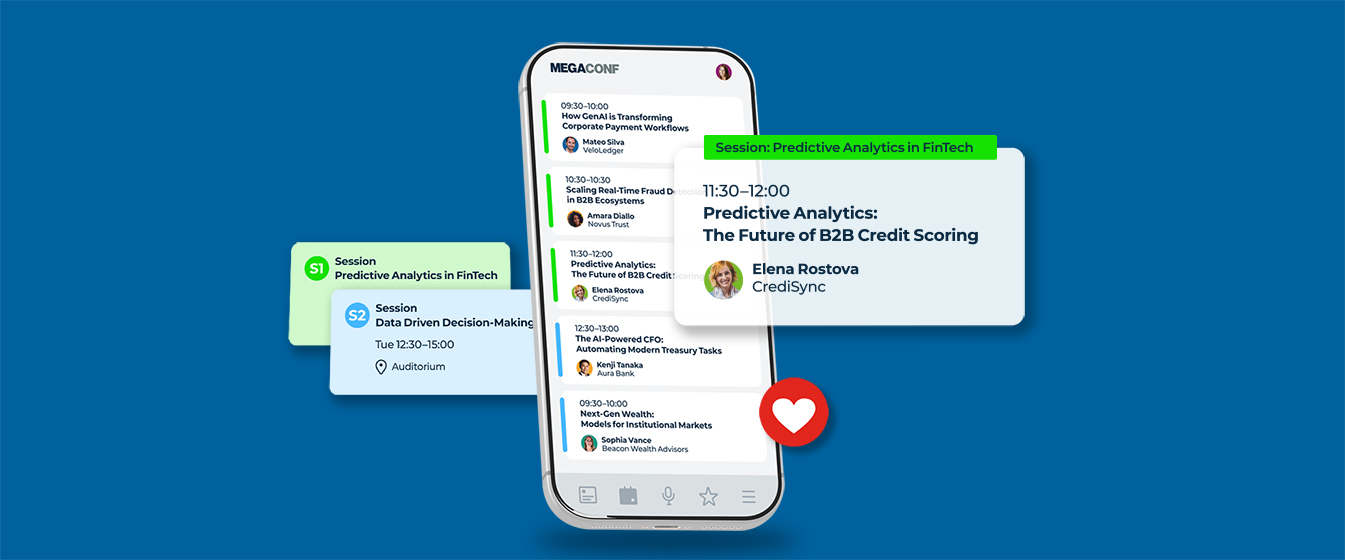
So, with this in mind, get your event mobile app’s matchmaking engine set up and deployed long before the doors open. Embed real-time data visualisers or ‘anonymous preview’ tickers on your landing page showing the breakdown of who is already registered. For example, your ticker might say something like: ‘Connect with 45 VPs of Data Science from Fortune 500 companies’.
Now you’ve shifted the marketing narrative from ‘Come and watch these interesting presentations’ to ‘come and hang out in-person with your peers who are facing and solving the exact same challenges as you are’.
Deep integration is the key
To be able to execute any of this, you’re going to have to get your systems to communicate natively across four pillars:
1 The sensor array (intent and tracking)
CRM data + 6sense / Bombora to identify who to target and when.
2 The delivery vehicle (paid social and automation)
LinkedIn Thought Leader Ads + personalized email flows to reduce friction.
3 The frictionless gateway (registration platform)
Dynamic, minimal forms that swap user data for immediate digital value.
4 The retention hook (event app engine)
AI-driven matchmaking that guarantees high-value peer networking.
Modern, full-service event platforms like AttendZen deliver a huge advantage when it comes to capturing the value from your tech stack.
For example, our attendee apps are automatically generated using the same data and codebase as our registration and email marketing engines.
And our customers benefit from our bespoke approach to building highly nuanced, bi-directional integrations with their preferred third-party enterprise CRMs, martech and predictive analytics tools.
By upgrading your tech stack from a simple database tracker to an active, intent-driven engagement engine, you can stop blindly chasing marginal sign-ups and start cultivating a highly curated and loyal community of stakeholders.
If you’d like an informal chat about some of the ways you could leverage the tools in your stack to raise your delegate acquisition game, we’d love to hear from you.